Monday, June 7, 2010

my job


~ - ~

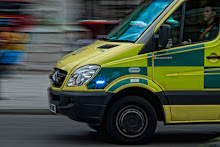
Recently, I was at  Ambulance HQ for some further training. I had my uniform on, whilst getting out the car a fellow got out of his car next to me. "You guys do an excellent job!" he stated, adding a few more compliments to the monologue. All I could stammer was "Ah, its an easygoing job, cheers, good fun, nice to meet you, thanks, good bye". Talk about an inadequate answer….

I felt silly after that. There he was, Joe Blow, thanking me, Yours Truly. Saying thanks on behalf of the public to my profession. And i wipe it away, play it down as if it were some kind of game, not worthy of mentioning.

~

Not long ago, a colleague unfortunately had the 'pleasure' of seeing the other side of the Emergency Department - as a patient. During treatment and assessment, the doctor walked up to my colleague and stated "I couldn't do your job".

Sure, our workspace may be a little volatile at times, strewn with uncertainty. Sometimes outnumbered, sometimes running out of hands. There we stand, in front of whoever called us for whatever reason. We stand in their world, but have to tell them that they now have to play by our rules. Need a hand? Call another crew, wait 5-50 minutes. Patient lying awkwardly in the bathroom? It might be awkward getting him or her out. Hasn't flushed the toilet? Might be a little smelly. Didn't quite hit the toilet bowl? Makes extrication easier, as the floor is already slippery.

But it beats having to go to work five out of seven days to an office, seeing the same people again and again, and sitting on yer bum staring at a screen.

Chances are, I couldn't do your job either.

~

"You must see some horrible things"

"Yes, and I'm looking at one right now"

In all honesty, most situations are abstracted for treatment (and survival). Patients become dehumanised, are a bundle of symptoms just waiting to be treated; and if they can talk, you try out a bad joke to test their sense of humour (and you can then reenter the real world again). Most situations are horrible for the people involved - mostly because people panic and common sense (if they ever had any) flies out of the window; or in a minor amount of cases, because someone is quite sick or even dead.

But it is the patients emergency. At the end of the day I don't know them. Their pain is visible to me, I can usually imagine that If it were me in the same situation I would be equally sad/distraught/griefstricken. But I'm not. I walk out of that job and that's that job emotionally done. The only memories are professional ones.

~

"Thank You"

"Your Welcome". No other reply necessary. Sweet, Sincere and Simple.

~

"You boys are heroes"

No we're not.

"Arm das Land das Helden noetig hat - Unlucky the nation that needs heroes"
(Galilei, in B. Brechts "Das Leben des Galileo).

Tuesday, June 1, 2010

tidying

Recently, I cleaned up the bedside table at the ambulance station. It was full of readers digest and various womens magazines from the past 20 years, mixed with a single epaullette, a lightglobe and a lone raisin.

And a book: "Picking up Girls", by Ira Alterman, published in 1982. Just right for some down time on a night shift.

Browsing the index, the chapter "How to get out of a girls house during a one night stand" caught my eye. Flip to page 55, there are some great words of wisdom:

"Someone, somewhere has left there car lights on. I'm going to find them and turn them off"
"I'm so happy I could run around the block. Here, let me show you!"


- - - End of public service announcement - - - 

Wednesday, May 5, 2010

To all fellow students


This semester is full on. We have two major units to complete, paediatrics and obstetrics. Both are of the category 'own worst nightmare calls', as a) I can't relate to the jobs (not being female and not being the best around kids), and b) due the the above I don't take as much of an interest in them.

Funny thing that. You don't like those type of job, so you try avoid learning about them as well.

So I actively try to overcome this fear. Trying to plunge myself in to the depths of it all. We recently had a near-birth situation - luckily, we arrived at hospital on time. Good thing we did, because the wee one didn't want to come out on his own, and Doc needed to use the Ventouse (suction cap). Once out, baby was bluey-purple, floppy, and not screaming. If that had have been in the back of the truck, chances are that I would have been screaming instead...

Suction and some vigorous towel rubbing turned kiddo in to a crying pink little bundle of something in less than ten seconds though. 'Nuther lesson learnt.

At the end of the day, young people can easily flip the panic switch in my world. I just cannot relate to them. A fact that won't change anytime soon.

---

I actually meant to write this post about how an extreme workload at university can have a negative impact on your patient care (goes to show I probably needed to vent something else!). I've been very busy lately, and the last couple of days at work have seen a slightly tired and mediocre approach.

Anybody else have similar experiences?

Tuesday, April 27, 2010

thoughts

So, there I am, standing on a bed, holding an elderly lady on all fours; all while my colleague stabilises her hips and the son cleans the aftermath of an eruptive diarrhoeal episode.

And I think to myself: what a wonderful job.

Sunday, April 18, 2010

Please give a very warm welcome to...

...the new students that hit the road today! They're a good bunch, enthusiastic and eager to learn.

All the best to all of you, and looking forward to seeing you out there!

(and by the way, it's my 1st anniversary in this job - one whole year of being out on the road! Hooray to me!)

Thursday, April 15, 2010

Stories from ED

Chatting to a nurse in an emergency department  the other night. We had just handed over a patient who had left a few crawling insects on our stretcher. Talk topics ranging from various body parts to bodily fluids over to cleaning up:

Nurse: "We recently cleaned out the the kitchen and found a finger in the fridge"

Tuesday, March 30, 2010

Murphy Time


If you ever find yourself at the beginning of a shift without a wristwatch on, you are guaranteed that
a) you will immediately get a priority one call, making you forget to attach said watch to wrist
b) be busy for the next eight hours and never get back to the station
c) never know what time it is
d) you always have to ask a patient/bystander/colleague what time it is (for documentation)
e) you will get an obstetrics job without any way of timing contractions
f) you will get an overdose job without any way of timing the respiratory rate.

...wait, methinks.

If you have a patient attached to your (loudly beeping) cardiac monitor with a heart rate of 90, instead of counting breaths for 15 seconds and multiplying by 4 (to get to 60 seconds), all you do is count breath sounds with your left hand, whilst counting monitor beeps in your head.
4 breaths every 18 beeps (12 seconds) equals a respiratory rate of 20.

What would we do without the machine that goes 'bing'?